
Case Study: Rethinking Booking Around the Chair, Not the Stylist
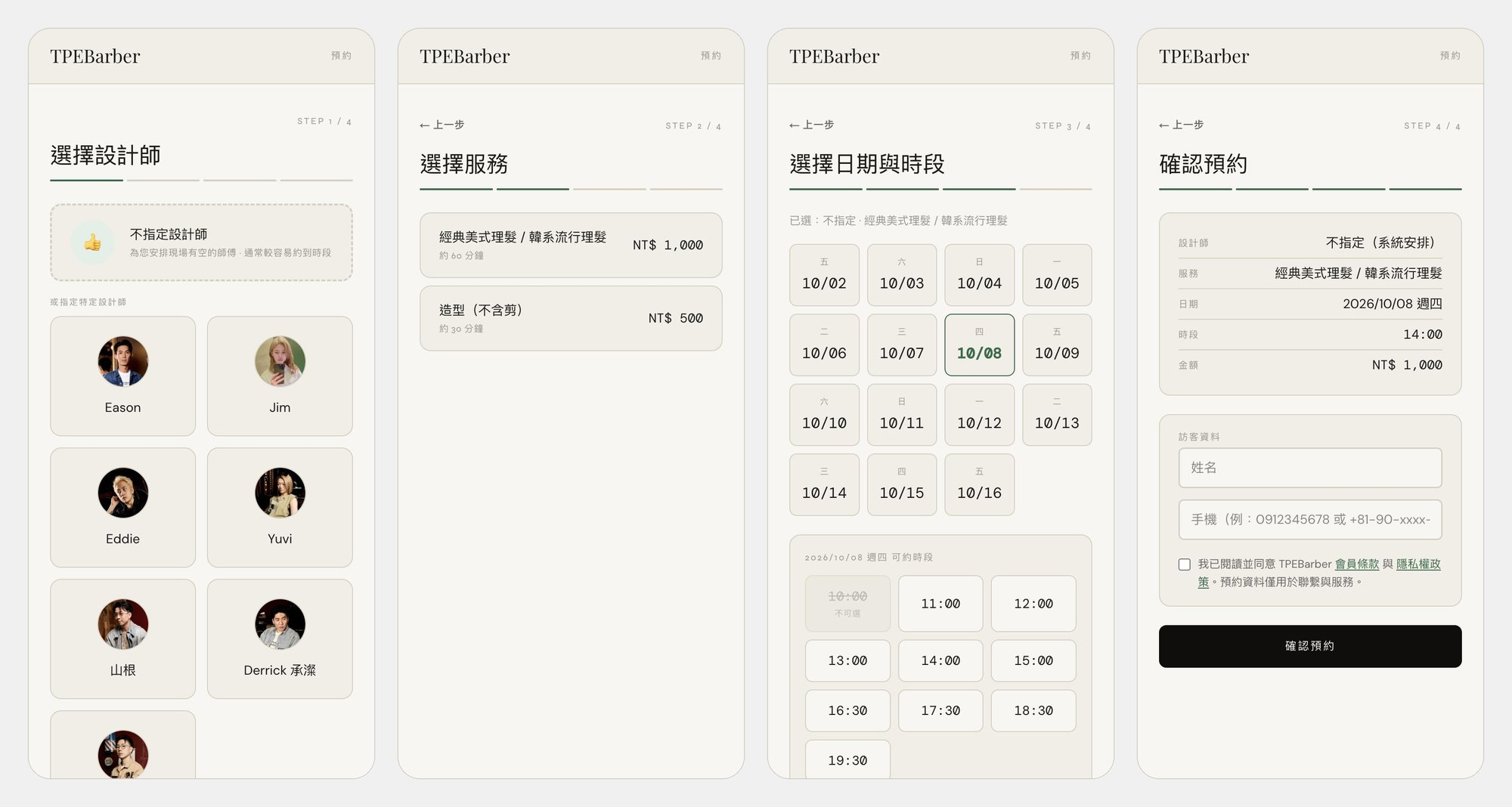
We built this custom booking system for TPE Barber, a barbershop in Taipei. It runs the shop every day at book.tpebarber.com. What we want to share is not the features. It is where the booking logic came from.
Starting on the shop floor
Before building anything, we visited the barbershop, watched it at work and talked at length with the barbers about how they take customers and plan their time.
Those conversations led to something we had not expected. For a barbershop, what matters is the number of seats, not which time slots a barber has open. One barber can run different services in the same time slot and use two seats at once.
Redesigning the booking logic
Most booking systems are built around people: the customer books a stylist's time. That model cannot express how the shop really works, so we redesigned the logic around a free seat with a barber tied to it. This is how it works:
1. The smallest unit is one time slot on one seat. What gets booked is the use of a particular seat at a particular time, not a stretch of a barber's schedule. Each seat has its own set of open time slots.
2. Seats are tied to barbers. Every seat belongs to a barber, and one barber can hold two seats. When a barber runs two different services in the same time slot, the system holds one booking on each seat, exactly as it happens in the shop.
3. Seats decide capacity. The number of customers the shop can take in a day equals the open seats multiplied by each seat's open time slots. Whether a time is still available is the number of open seats minus the seats already booked.
4. Requested and unrequested bookings follow the same logic. When a customer requests a barber, the booking lands on a seat tied to that barber. When a customer has no preference, the system confirms a seat is free at that time and then assigns a barber by the shop's rotation order.
5. A long service holds the following slots. A service of two or three hours keeps the same seat through the later time slots, so no other booking is placed there.
6. One seat at one time takes one booking. When two customers submit at the same moment, the system accepts one, and the other customer sees the remaining times.
The core of the logic is to look at seats first and then match the person. The resulting schedule is the shop's real day.
The other half of a custom booking system: a better front end
Alongside the new booking logic, we improved the customer's booking flow, with the aim of reducing friction at every step. The whole flow has four steps:
- Choose a barber. Customers can request a barber or choose "no preference", and the system assigns a barber who is free.
- Choose a service. Each service shows its duration and price.
- Choose a date and time. Once a date is picked, the times open that day are listed, and fully booked times are marked as unavailable.
- Confirm the booking. Customers review the barber, service, date, time and amount, enter a name and phone number, and submit.
Other improvements:
- No sign-up required. A visitor can book directly, and regulars sign in with LINE so their details are filled in.
- Built for the phone first. Most customers book on a phone, so layout and buttons follow how a phone is used.
- Progress is always visible. The top of the screen shows the current step, and customers can go back a step to change a choice.
Listening until it was right
Throughout development we went back to the shop again and again to hear the barbers, adjusted the system to how it felt in real use, and delivered a system they are satisfied with.
Logic that scales
Booking by seat does not belong to one shop. We designed the logic to scale to any brand in the beauty industry: barbershops, hair salons, nail studios and beauty salons. Any business that serves customers by seat or bed can use it.
To see how we work, read about custom software development, or contact us.
Comments