
3D Jewelry Configurator: 4 Decisions for Luxury Watch and Jewelry Brands in 2026

Around 70% of the watches Porsche Design builds by hand in Solothurn, Switzerland, are custom orders. Bain and Altagamma's June 2026 luxury update names jewelry as the strongest category right now, and lists giving clients a way to co-author their pieces as one of three imperatives for brands. High-end jewelry and watch clients increasingly want to see their own choice of diamond shape, metal, engraving and strap together before they commit. A 3D jewelry configurator is the system built to answer that. This article looks at it from a development point of view: the four decisions luxury jewelry and watch brands should make before building one, and the pitfalls that come with each.
What a 3D jewelry configurator actually does in luxury sales
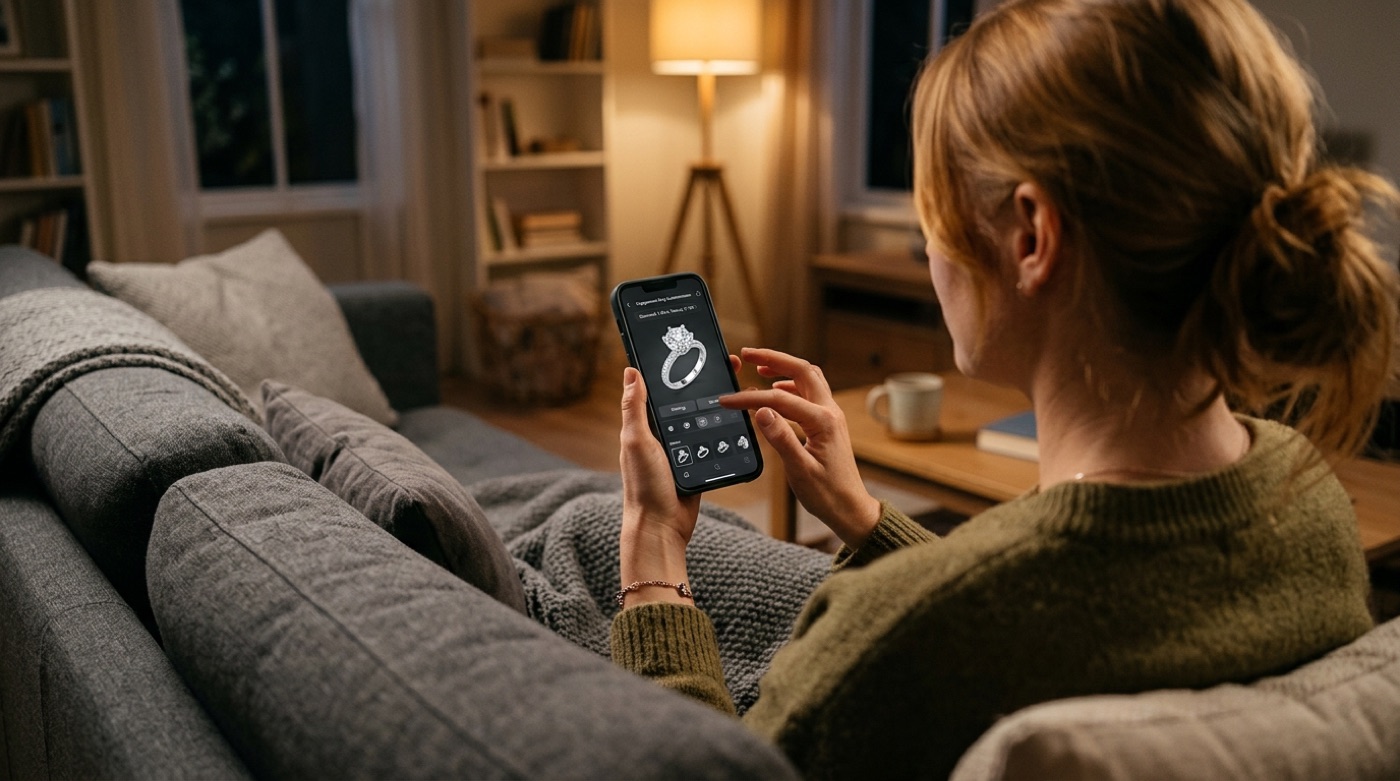
Start with a few that are live today.
Van Cleef & Arpels runs a "Compose your engagement ring" page for its Your Poetic Setting collection. Clients choose the setting, carat weight, color and clarity, then type the words to be engraved inside the band and see the engraving update in real time. The page states that the engraving preview is illustrative and may vary with ring measurements, and it flags characters that can't be engraved. Hapticmedia, which built the 3D, says its designer visited the maison's workshops to learn the collection's rules and history before modeling.
Courbet's engagement ring simulator lets shoppers choose ring size, band material and diamond cut, with light and facets simulated live in the browser. Piaget turned its Altiplano configurator into a sales tool for boutiques and travelling sales teams: on a tablet, clients can apply more than 30 materials and engraving patterns to the watch and even watch the movement run.
Porsche Design goes furthest. Its Timepieces configurator, rebuilt in June 2025 by Porsche Lifestyle Group and MHP, renders in Unreal Engine, streams through AWS and connects directly to the Porsche car configurator: the dial ring can match any of 142 exterior paints, the strap can use the car's interior leather, and the finished watch can be ordered at participating Porsche Centers.
What these have in common: the configurator isn't a toy on the website. It's the system that connects the atelier's rules, the boutique's sales process and the client's imagination. Much of what we covered in 3D car configurator development applies here, but jewelry and watches bring their own problems.
Decision 1: How real do diamonds, metals and movements need to look?

Light is the hard part. A diamond's fire comes from light reflecting, refracting and dispersing between facets; the sense of value in metal lives in the small color difference between 18k rose gold and platinum. Get it wrong and clients immediately see "video game", which hurts the brand more than having no 3D at all.
There are three technical routes:
- Real-time rendering in the browser (WebGL / WebGPU): the Courbet approach. It's responsive and has no cloud GPU bill. Since November 2025 WebGPU ships in Chrome, Edge, Safari (iOS 26, macOS Tahoe 26) and Firefox on some platforms, so browsers can now handle far richer lighting than a few years ago.
- Cloud streaming: the Porsche Design approach. Image quality is the highest, but every concurrent visitor occupies a cloud GPU, so cost rises with traffic.
- Pre-rendered image sequences: every combination is rendered in advance as multi-angle images or short clips. Quality is consistent and phones run smoothly, but files and production time explode as combinations grow.
In practice most teams mix them: real-time rendering for the center stone and metal, pre-rendered close-ups for the moments that matter most, such as diamond fire under a spotlight or a guilloché dial. Test on mid-range phones, not the designer's workstation. Many luxury clients open a configurator for the first time on their phone.
Decision 2: Write atelier rules as data, not code

The real core of a configurator isn't the 3D. It's the rules: which settings take which carat range, which metals can't be paired with which stones, how many characters an engraving allows, which characters the workshop can't cut, and what each combination costs, or whether it should switch to "price on request".
These rules belong in a data table that the atelier and merchandising teams maintain in an admin panel; the front end and 3D simply display what the table says. The reason is simple: luxury houses launch, retire and reprice pieces every season. If rules are hard-coded, every change waits for an engineer and the configurator drifts away from what can actually be made. Van Cleef & Arpels' "illustrative preview" note and its live warning on disallowed characters are good examples of rules and presentation staying honest with each other.
The step most worth the time before development starts is the one Hapticmedia took: go to the workshop and ask about every "you can't do that" before modeling anything.
Decision 3: Hand the configuration to the boutique, the advisor and the CRM

Fine jewelry and watches are rarely bought through an online checkout. After configuring a ring, the next step is usually booking a boutique visit, talking with an advisor and seeing real stones in person. So the configurator's finish line isn't "add to cart". It's handing the full configuration to the next person:
- Every configuration needs a shareable link or code, so a client can send it to a partner and an advisor can pull up the same view in the boutique.
- "Book an appointment" or "Have an advisor contact me" forms should carry the configuration with them, so the client never has to describe it again.
- Configuration history should flow into the CRM: which designs a client viewed and which carat weight they hesitated over are leads for the advisor's next conversation.
Piaget's tablets in boutiques and Porsche Design's "configure online, order at the Center" follow the same logic: online and offline share one set of data. That's custom software development, not just web design, and it should be planned from day one.
Decision 4: Off-the-shelf platform or custom build?

There are plenty of 3D configurator SaaS platforms, including Threekit, Hapticmedia, Apviz and Emersya, some specializing in jewelry and watches. A rough guide:
- Standard product structure and a small catalog (for example setting + center stone + metal for engagement rings): an existing platform launches faster with mature templates.
- Deep integration with your own CRM, booking, inventory or quoting, or a brand that wants a truly distinctive look and interaction: custom development fits better, and the 3D models and rule data stay with the brand.
- Either way, confirm who owns the 3D models and rule data, how the platform charges for views or configurations, and how multiple languages and market-specific pricing are handled.
AI can help with parts of this, such as drafting product copy or translations. Bain also reports that about half of luxury consumers already use AI somewhere in their purchase journey, often to compare products, so the cleaner a configurator's data structure, the better a brand's chances of being understood correctly in those new channels.
We followed the same thinking when we built the Venus Aurelia yacht showcase: visitors drag the 3D yacht to view it in 360°, switch hull finish and accent metal, then "Arrange a private viewing" that hands their interest to a real salesperson. Different industry, same problem a luxury configurator has to solve.
Conclusion: Decide who it hands off to, then how real it needs to look
The most common mistake with a 3D jewelry configurator is spending the whole budget on how beautiful it looks without deciding who maintains the rules or who receives the finished configuration. For luxury jewelry and watch brands, a good configurator does three things at once: it makes clients believe what they see is something the atelier can actually make; it lets advisors pick up without starting over; and it lets the brand update its collection each season without rebuilding the system.
If your brand is evaluating a 3D configurator, online customization or a book-a-visit flow, talk to TitApeX. We plan atelier rules, 3D presentation and system integration together, so technology handles precision and people handle the emotion.
References
- Porsche Design: Revised Timepieces configurator press release (2025-06-27)
- Bain & Company: Global luxury spring 2026 update press release (2026-06-25)
- Van Cleef & Arpels: Compose your engagement ring
- Hapticmedia: Van Cleef & Arpels engraved ring 3D configurator
- Hapticmedia: Courbet engagement ring simulator
- Hapticmedia: Piaget watch 3D configurator
- web.dev: WebGPU is now supported in major browsers (2025-11-25)
Comments