
3D Car Configurator Development: 4 Decisions for Supercar Brands in 2026

Lamborghini delivered 10,747 cars in 2025, and 94% of them carried at least one Ad Personam customization. Almost nobody buys a "standard" supercar. Before signing, clients want to know how the paint reads in sunlight, whether the stitching works with the leather, and whether a different wheel changes the side profile. A brochure and a salesperson's description can't answer those questions, which is why the 3D car configurator has moved from a fun feature on the brand website to a system the supercar sales process actually runs on. This article looks at it from the development side: four decisions supercar brands and dealers need to make before building one, and the pitfalls we see most often.
Why the 3D car configurator became a supercar sales system

Porsche is the clearest example. When the Cayenne Electric premiered in November 2025, Porsche launched a new interactive 3D visualization platform alongside it. It runs on the Elastic Content Platform, developed by MHP with Porsche Digital, renders in real time with Unreal Engine, and is streamed to users via AWS. The same system serves the Porsche app, dealer showrooms and the client's computer at home, and extends to event tools, dialogue marketing and interactive after-sales instructions. MHP reports higher website traffic, longer visits and more configurations, with buyers trying more combinations and choosing more options (no percentages were published). In May 2026, Porsche even added an unlockable Fortnite viewing environment to the configurator, built on the same Unreal technology.
The point is that it is one system. A car configured at home should appear unchanged on the salesperson's screen in the showroom. The social images marketing needs and the showroom display a dealer runs should come from the same vehicle data.
Buyer behavior is pushing the same way. In Cox Automotive's latest Car Buyer Journey Study, only 7% bought a car completely online, but 63% said a mix of online and in-person would be ideal. Supercars take this further. Nobody buys a Revuelto with one click, yet almost everyone configures the car several times online before walking into a showroom.
Decision 1: Cloud streaming or rendering in the browser

Technically, there are two main routes for a 3D car configurator.
Cloud streaming (Pixel Streaming): the car is rendered on cloud GPU servers with a game engine such as Unreal, and the frames are streamed to the user's browser like video. Porsche and Pagani both take this route. Back in 2020, Pagani and MHP launched the Pagani Immersive Experience Platform at every Pagani dealer worldwide, letting clients configure a Huayra Roadster BC down to the tires and interior, switch between a coastal road and a racetrack, and export the result as a shareable video. The upside is image quality that doesn't depend on the client's device; ray tracing and layered metallic paint are possible. The cost is that every concurrent user occupies server GPU time. An AWS g4dn.xlarge runs about $0.53 an hour and handles one to four streams depending on scene complexity, so the bill grows linearly with traffic, and network latency directly affects how responsive it feels.
In-browser rendering (WebGL/WebGPU): the model downloads to the client's device and the phone or computer does the rendering. Server cost barely changes with audience size and interaction is instant, which suits high-traffic places like the brand site or a social ad landing page. The trade-off is that models must be heavily optimized, older phones struggle, and quality rarely matches streaming.
Our recommendation is to start with one question: where is this configurator's most important audience? If it lives mainly on showroom screens, or only opens to clients with an appointment, streaming quality is worth the GPU bill. If its main job is converting large numbers of strangers from ads and search, in-browser rendering makes more sense. Porsche uses both: interactive 3D is streamed, while static 2D images are now generated on demand instead of pre-rendered in bulk.
Decision 2: Option rules and data are harder than the visuals
Many brands building their first configurator spend the budget on models and lighting, then discover after launch that the hard part is the rules.
Some wheels only pair with certain brake calipers. An interior color isn't offered in a given market. Choosing the carbon package rules out another exterior package. Prices, taxes and delivery times differ by country. These rules usually already exist in the factory ordering system, and if the configurator maintains its own copy, sooner or later a car that can be built online can't be ordered by the dealer. For a supercar client, that does more damage than a slightly less beautiful render.
Three things need planning up front:
- Where the rules come from: the configurator should read option rules and prices from the factory or dealer system rather than hard-coding them, so a model-year update changes one place.
- How assets are produced: turning engineering CAD into a real-time model means reducing polygons, splitting materials and calibrating color. Porsche's Color of Your Choice program offers more than 190 colors, and each must look right on screen. That takes a repeatable conversion and calibration pipeline, not manual tweaking every time.
- Whether bespoke options are included: programs like Ad Personam or Tailor Made often can't be modeled in advance. A common approach is to configure up to the standard options, then hand off to "book a design consultation," carrying the client's configuration along.
Decision 3: Connect the showroom and online into one journey

Much of a configurator's value happens after the client presses "save" or "enquire."
A car configured at home should generate a shareable configuration code or link that flows straight into the dealer's CRM. Before calling, the salesperson knows which color the client picked, how many times they changed it, which option they hesitated over longest and where the total landed. When the client arrives, the showroom screen loads the same car and the conversation picks up where they left off.
This data flow is what off-the-shelf configurators most often lack. Factory configurators usually just email the configuration to a dealer, and independent dealers, tuners and pre-owned supercar specialists often have no configurator at all. This is where custom software development earns its keep: connecting the configurator, enquiry forms, CRM and showroom screens around your own process, such as who answers which market, or whether allocated models need approval before a client sees pricing.
The supercar client base is also changing, with new models bringing in first-time buyers alongside long-time collectors who need a different experience. We covered client segmentation in Fewer Cars, Deeper Clients, which pairs well with this piece.
Decision 4: Not every interaction needs real-time 3D
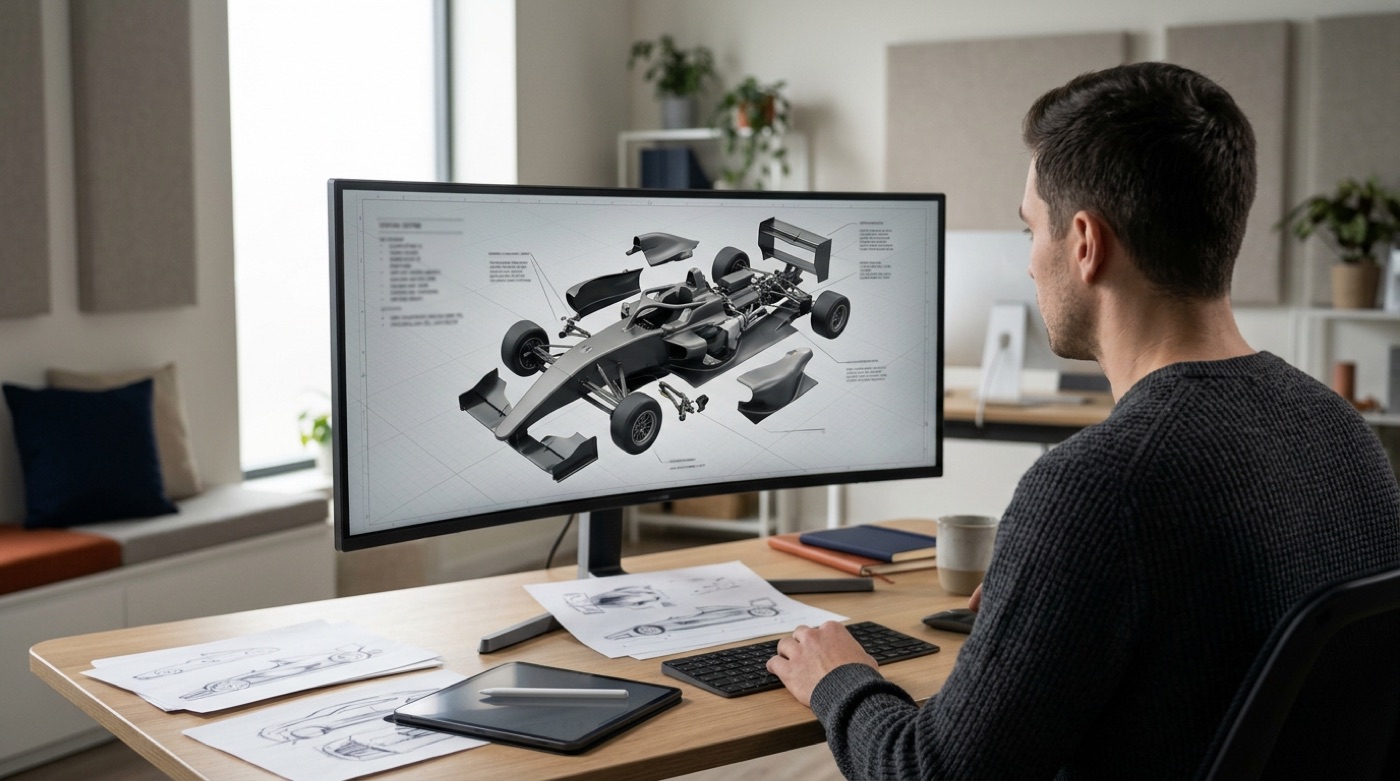
Real-time 3D is compelling, but it isn't the only option, and sometimes it isn't the best one.
APEX LAB, which we built, is an interactive F1 car breakdown. As you scroll, the car comes apart into nine components from front wing to rear wing, each with specs and how it changed from the previous rules; you can drag to turn the car, and choosing a team or driver switches the car across the whole site. The rotation uses high-quality images from multiple angles, while the circuit is an illustrative 3D model. That combination loads fast and runs smoothly on phones, and keeps the focus on helping readers understand the structure rather than modeling every bolt.
Yachts follow similar thinking. The site we built for Venus Aurelia lets visitors drag the yacht through 360 degrees, select zones from the upper deck to engineering, switch hull finishes in the Atelier section, and then arrange a private viewing.
The choice depends on what decision the client needs to make. Choosing paint and wheels means seeing light move across curved surfaces, so real-time 3D or high-quality renders are worth the investment. Understanding a car's aerodynamics or a yacht's layout is often clearer, and cheaper, with scroll-driven storytelling and images at key angles.
Common pitfalls before launch
- Testing only on high-end office machines: most clients open the ad link on a phone. Test on mid-range phones over ordinary 4G.
- Uncalibrated color: the red on screen can look very different from the red on the car, and clients notice in the showroom. Check key colors against physical samples.
- No one owns model-year updates: options and prices change with each model year. Agree before launch who updates them and how often.
- No tracking: without knowing where clients drop off or which colors they choose most, the configurator is just a pretty page.
Conclusion
A good 3D car configurator means clients have configured the car several times before they walk into the showroom, and the salesperson takes over a buyer who already knows what they want. A poor one is an expensive demo. The difference is rarely how realistic the render looks. It is whether the rules, the data flow and the showroom process behind it are connected.
TitApeX builds 3D interactive websites, configurators and the client systems behind them for high-end brands, from choosing the technical route to the model and data pipeline and CRM integration. If you are evaluating an online configurator for supercars or premium vehicles, let's talk.
References
- MHP: Porsche adopts holistic solution for interactive vehicle visualization (December 2025)
- Porsche Newsroom: Porsche introduces Fortnite theme as Cayenne Electric arrives in the online game (May 2026)
- Autocar Professional: Automobili Lamborghini Reports €3.2 Billion Revenue in 2025 (March 2026)
- Cox Automotive: Car Buyer Journey Study finds efficiency, digital tools and AI drive record satisfaction
- MHP: MHP and Pagani launch real-time automobile configurator (December 2020)
- Abratabia: Unreal Engine Pixel Streaming Hosting
- Vagon: Cloud Streaming vs. WebGL Configurator
- AWS: Amazon EC2 G4 Instances
Comments