AI Document Review: Let AI Check Your Proposals and Reports Before They Go Out

Proposals, quotes, annual reports, contract summaries: many companies now draft them with AI, several times faster than before. But the faster you write, the faster mistakes travel. One fabricated citation or one set of numbers that doesn't add up, and it lands on a client's desk as a credibility problem. On October 14, 2026, Google publicly released Deep Review, which uses a team of AI agents to check long documents for logic, numbers and citations, with two free reviews per user each week. That moves AI document review from a research-lab experiment to a checkpoint any business can build into its daily workflow. Here is how it works, which documents it suits, and which judgments still belong to people.
Why AI Document Review Matters Now: Faster Drafts, Farther-Reaching Errors

In October 2025, Deloitte Australia agreed to refund the final installment of an AU$440,000 contract with the Australian government. The roughly 237-page report contained references to academic papers that did not exist and a fabricated quote attributed to a judge; the revised version added a disclosure that generative AI had been used in its preparation. The report's conclusions did not change, but the damage to trust was done.
The lesson is not "don't use AI." It is that the process was missing a check. When drafting speeds up tenfold but reviewing effort stays the same, errors go out the door untouched. For a small business, a quote with the wrong total or a proposal citing the wrong regulation can cost more than the time AI saved.
How Google Deep Review Handles AI Document Review: Agents Checking in Parallel

According to Google Research, Deep Review doesn't have one model read from start to finish. It divides the work:
- Segmentation: the document is split into logical segments that together cover all the content.
- Compute by density: proof-heavy, data-dense sections get more compute; introductions and background get less.
- Parallel verification: specialized reasoning agents check each segment at the same time, with access to the whole document for cross-references.
- Synthesis and grounding: a final agent consolidates the findings, checks for contradictions between sections, and verifies facts externally.
It was built for academic papers and piloted with STOC, ICML, NeurIPS and ICLR across more than 16,000 submissions; it now extends to design documents, presentations, and legal and financial documents. A test reported by Korea's Digital Today found that on 26 papers containing 29 confirmed errors, the system caught 89.7%, while Gemini 3.1 Pro alone caught 55.2%. In other words, how you review matters more than which model you use.
Which Documents Deserve a Round of AI Review
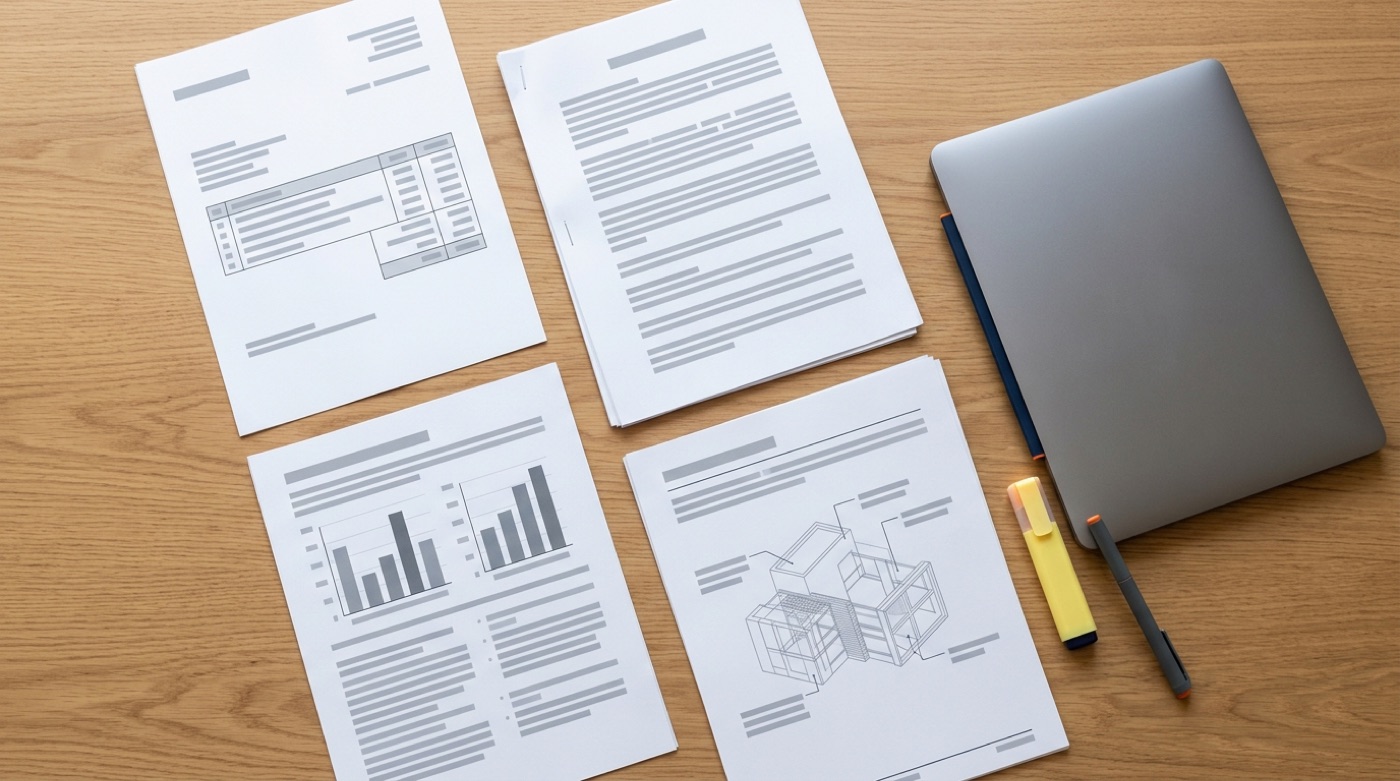
Not every email needs AI review. Start with documents that are hard to take back once they're out:
- Proposals and quotes: do totals add up, and do specs and prices match throughout?
- Annual reports and investor decks: do growth rates, charts and narrative agree?
- Contract and terms summaries: does the summary leave out key limits in the original?
- Product specs and manuals: do parameters contradict each other across sections?
- Published research and white papers: does every citation exist and say what you claim?
What these share: they are long, number-heavy, and read line by line by clients. That patient, detailed cross-checking is exactly what AI does well.
Three Boundaries for AI Review: Data, False Alarms, Final Sign-Off
AI review is not magic. Agree on three things before you roll it out:
- Where the data goes: Google says uploads are not used to train its models but are stored for one year so users can revisit reviews. Documents containing client personal data, unpublished financials or contract values should be anonymized first, or reviewed with an enterprise tool your company has approved. For workplace AI rules, see our earlier guide, four rules for AI memory at work.
- False alarms need a human: reports note the system sometimes flags valid proofs as errors. Every issue AI raises is a to-check list, not a verdict.
- People make the final call: Google itself says higher-level judgments are left to humans. A document's stance, tone and promises to clients must be owned by someone who signs off.
Building AI Review Into Your Workflow: Four Steps

- Define what must be reviewed: list your external documents and mark which types require AI review.
- Write a clear review prompt: ask explicitly for checks on number consistency, whether citations exist, contradictions, and missing conditions.
- Assign a human reviewer: each document has an owner who works through AI's comments and decides what to accept or reject.
- Keep a record: save AI's comments and how they were handled, so you learn which errors happen most often.
Conclusion: AI Finds the Errors, People Take Responsibility
AI makes writing faster, and it makes careful review affordable. The real advantage isn't producing the most documents with AI; it's sending out the most reliable ones. That is what TitApeX means by "AI delivers perfection, people deliver emotion": let AI keep typos, wrong numbers and fake citations out, so people can focus on perspective, judgment and client relationships. If you want to bring AI review or other AI workflows into your team, explore our services or get in touch.
Comments