Built in a Week, Too Risky to Change: Ask About Software Maintainability Before You Commission Custom Development

AI has made writing code faster; nobody disputes that any more. But software is not finished when it is written. After launch come new features, new integrations and fixes, usually for years. What decides whether that work is smooth or painful is a term that rarely appears on a quote: software maintainability. In its 2026 annual study, Dutch software quality consultancy Software Improvement Group (SIG) analysed more than 30,000 enterprise systems and over 400 billion lines of code. Its conclusion is blunt: AI neither improves nor harms software automatically. It amplifies the engineering discipline a team already has. This article covers the key findings and four questions business owners should ask before commissioning custom development.
What the research says: AI amplifies discipline

According to IT Brief's June 2026 coverage of the report, a few numbers stand out:
- 86% of code falls below SIG's recommended maintainability rating, and half falls below its recommended architecture rating.
- Systems with stronger architecture resolve issues 30% faster.
- Productivity gains from AI coding drop off sharply once a codebase reaches around 100,000 lines, because language models struggle to grasp complex overall architecture.
- In SIG's testing, AI-generated code carried roughly twice the security risk violations of human-written code.
The report also describes one case: a system built by autonomous AI agents in a week, at a cost of EUR 10 to 15 million in AI usage fees, with code described as nearly unmaintainable.
A caveat: these figures come from SIG's own benchmark, which is weighted towards large enterprise systems and does not represent all software. In that benchmark, AI-generated code currently makes up only 1.9% of production code. The issue is not how much AI writes. It is what SIG's chief executive Luc Brandts put this way: you cannot manage what you do not measure, and you cannot sustain speed on a foundation you do not understand.
What software maintainability is, and why owners should care

Software maintainability describes something very practical: how much time and risk a future change will cost.
For a business owner, poor maintainability shows up like this:
- A change that sounds simple comes back with a surprisingly high quote and timeline.
- Changing feature A breaks feature B.
- After the original engineer leaves, nobody dares touch the system, or the new team recommends a full rewrite.
- You want to connect a new tool or an AI feature and find the system left nowhere to plug it in.
On its own podcast, SIG notes that technical debt is shifting from the code level to the architecture level, while AI generates code faster than teams can review it. In plain terms: AI can do a decent job on a single piece of code. How the whole system is divided up and how its parts talk to each other is another matter, and when those decisions are wrong, every later change pays interest.
Four questions to ask before commissioning custom development

1. Who decided the architecture, and is it written down?
Ask for one diagram showing the system's main parts and what each is responsible for. You do not need to follow every detail. You do need to confirm that someone thought these decisions through and recorded them, rather than accepting whatever the AI produced.
2. What happens when the system grows?
The research shows AI's benefits fall as the codebase grows. Ask how they keep the system from tangling as features pile up. A sound answer mentions modular boundaries, clear interfaces and time set aside to tidy the code.
3. Could another team take over?
This is the most practical test. Confirm that delivery includes ownership of the source code, setup and deployment instructions, and a record of the main design decisions. If only the original author (or the original AI conversation) understands a system, all of the risk sits with you.
4. How is quality measured?
"We take quality seriously" is not an answer. Ask: is there code review? Who reads the AI-generated code? Are tools used to check complexity and duplication? Can a short quality report come with delivery? We cover the testing side in more detail in our separate piece on the testing questions to ask before commissioning development.
AI writes; people own architecture and trade-offs
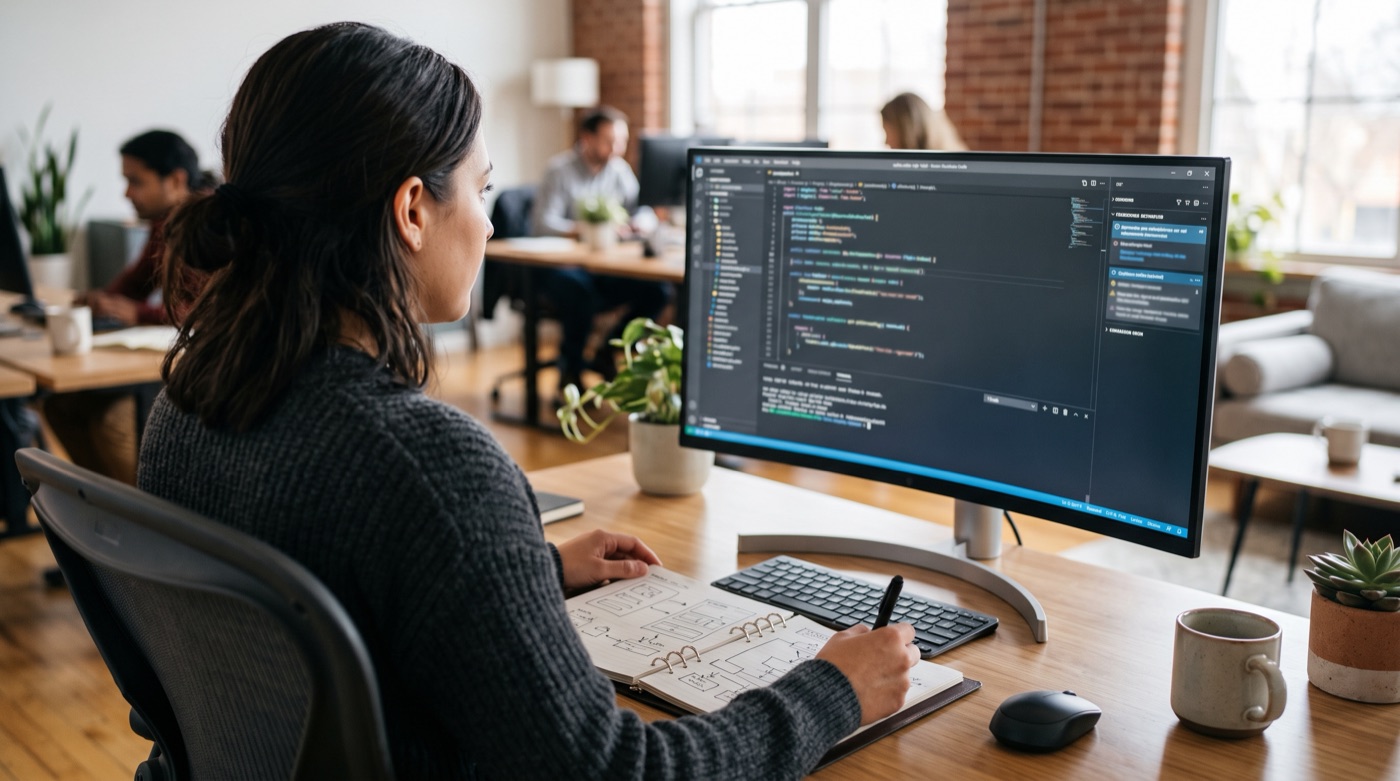
In maintainable systems, the split between AI and people is usually clear.
- AI handles: writing code within the agreed architecture and conventions, generating tests, tidying documentation, flagging duplicated or overly complex sections.
- People handle: deciding how the system is divided, judging which parts are most likely to change and need flexibility, reviewing AI output, explaining trade-offs to the client, and choosing between "faster" and "easier to maintain".
Those judgements depend on understanding your business: which process will change next year, which feature will never be used. That is the part AI finds hardest to replace, and the ability most worth looking for in a development partner.
Conclusion: the cheap part is not building it, it is being able to change it

AI lowers the cost of getting software built, but the real cost of software has always been in the maintenance and changes that follow. A few extra questions about software maintainability will not slow your project down, and they mean you can still change your own system three years from now. That is how TitApeX approaches custom development: "AI handles perfection, people create what moves you". Speed goes to AI; architecture and judgement stay with people.
If you are evaluating a custom system, or living with an old one nobody dares to change, take a look at our services or simply talk to us.
Comments